Friday, 7 July 2017

Battle of the Bastards

It was high time I jumped on the bandwagon and watched Game of Thrones. So in midst of exams, holiday shopping, moving houses, and all the packing, and re-packing and packing, I still found myself enough time to sit down five to six hours a day, to finish all six seasons right before the holidays started.
The show (as a whole) is beyond phenomenal, there is no doubt about that, but there is one episode in particular I would like to talk about - Episode 9 of season six, - Battle of the bastards.
It is a simple good vs. evil fight, resolved on the battle field, but excellently shows the chaos, the confusion, the brutality and the implementation of the battle strategies on the actual scene of the fight. The allies and the enemies all look the same, and for some time we are as confused as Jon Snow on who exactly to fight. These are just men in mud, charging and killing one another. The bodies around him grow in heaps and the limb less ones twitch and groan in pain, but the fighting goes on - that's the reality of war.
So far in the series, such a exhaustive battle scene isn't shown. Daenerys conquers three cities through her words and her show of dragons and never does resolve to fighting. We never see Rob Stark fighting, but alone hear his praise. The battle of the Black Water was a test of wits - winning without actually fighting, and the war between Stannis and the Boltons was a mere shot from the sky, because it was very evident on who was going to win.
So now, we have the favourite character who has risen from the dead, and the other loathed, by us and the people on screen, and we all want him dead as soon as possible.
Both are bastards and both want Winterfell.
Jon Snow has a smaller army, an array of wildings and soldiers from his allies in the North while Ramsay Bolton has a bigger army, a hostage and also excellent battle strategy, making us want to root for Jon Snow even more.

First, *spoiler* Rickon Stark is killed, an arrow through his heart, on an empty battlefield, minutes before Jon Snow can save him. Jon is enraged and charges into battle, first on horseback, and then on foot and the background score heightens the tension. We see him alone on the field, and the Calvary approaching him, and just when we think it's all over, the allies are fighting by him. The music abruptly stops, and the cling and clang of the swords take over.

So far Jon has only fought in snow; the vast, empty white landscapes that are stained with blood after a fight. And now here he is in all the muck, and the dirt and the confusion and chaos. Ramsey's army on the other hand is well prepared. The scene where there corner Jon Snow and his men in a circular trap is ingenious. Jon is pushed deep down in the stampede as the Ramsey's men charge forward. He pushes himself up and comes out straining for breath, like coming out of water. Not far away from him, Ramsay is still clean, and hasn't found the need to get down from his horse yet. You detest him, but you need to appreciate the characters intelligence.

All hope is lost at this point, but after a period of tense silence, a horn blows, and from a distance, comes Little Finger's army charging forward.
Jon and Ramsey's fight eventually ends in an one on one, and several punches to Ramsey's face is as satisfying to us as it to Jon Snow and Sansa. There is one particular moment towards the end that really shows us how grown Sansa has become, in terms of her mindset. When Ramsey's own hounds devour him, she looks on, first with a flicker of pain, and looks away, but immediately turns back and relishes the moment of triumph.

On one side, you can call it a predictable episode; you know who is going to win, and who is going to die. But the dip and rise of suspense and tension is consistently maintained, making us root for Jon Snow throughout. The visuals are stunning, and the brutality on the scene of battle is true to life.

Monday, 8 May 2017

Out of the frying pan, and into Madurai.

The answer to this post.

Now we are blessed with heavy rains (& power cuts) every evening, but a week ago, Mysore was the brightest and the hottest it had ever been. It was agonizing to sit in class after lunch, drafting with our necks and shoulders bent and our foreheads dotted with sweat, while the fan spun rapidly over our heads to little effect.
The Good Friday – Easter weekend soon comes along, and while most people chose to stay at home, or travel to the nearby hill stations to cool off, I made my way to the hotter part of the country for the sole purpose of visiting the famous Meenakshi Amman temple whose plan and features I had memorized from PowerPoint presentations in my first year of college, and whose gopurams I had seen off rooftops of countless Tamil movies.
During my short stay, I observed only a tiny portion of Madurai, mainly the streets that surround the temple complex and maybe a little beyond that, but I discovered it to be a living, breathing, working oxymoron in itself – everything working with and against each other. It presents a synthesis of the past and present, residing side by side in harmony. Go to the stone pillared mandapas opposite the temple, which now houses a busy market. You can watch a tailor work away with his sewing machine right next to a tall, beautiful sculpture of a yali.The wide (pothole clear) straight roads are the sign of the once planned city, but the vehicles parked on the roads, and the rough traffic that flows in and out is a sign of today. The view that would have been once unobstructed towards the tall gopurams, are now littered with billboards of all sizes, and electrical wires hanging tangled and loose. Film posters and political propaganda are stuck or painted on walls, signifying the two obsessions that feeds the city now.


The streets all around the temple are filled with shops of all sorts, built and arranged to a setback, neatly falling in line, only varying in the length and depth, and the contents they sold. If not shops, there were coffee bars, and tiffin centers. Fresh smell of idils, dosas, and pongal wafted through the streets in the morning, and you could watch old men, in checkered lungis, sitting and sipping their coffee, reading a newspaper outside these coffee bars.

For breakfast, I myself had a masala dosa, hot and crisp, served on a fresh banana leaf, with no molaga podi (red chilli powder) smeared on the insides, just the way I like it. Accompanying it, was a bowl of sambhar, and three cups of chutney,- one orange - tomato, one white - coconut and one green – coriander. Also a humble representation of our tricolour flag, I must say. For lunch, it was meals, served hot and quick, with rice, three curries, and periodic servings of sambar, and rasam being served on a fresh banana leaf, along with a cup of curd, and delicious payasam.
The process is simple. Pay first, and get a token. Sit at any empty seat, and whoop! A fresh bright green banana leaf is placed in front of you, then a glass of water, and then a bowl of rice. Then comes a hand, and you are served three different curries, then sambar, and then comes the bowl of curd and sweet. If anything has to be refilled, just a flick of a hand, and whichever server spots you, he comes to you with the cylindrical steel bucket tucked in his hand and whips out whatever you dish you asked for.

Coming to the temple, our first destination of the day, where we wandered in and out, out of countless halls, admiring the intricate and dedicated stone sculptures and cravings all over the walls and columns.


We made our way inside, fortunately without having the trouble to stand in a long queue.
We entered to a dim, cool colonnaded hall. It had a high ceiling, supported by the row of tall stone columns, in between which were snuck small stalls, illuminated by a hanging bright yellow fluorescent bulb. At the end of the hall, in the next mandapa, the golden dwajasthambam glimmers in a golden light with the focus of two spotlights. The inner halls get even dimmer, and just wallow in the glow of the tube lights or an occasional opening, that lets in the bright sunlight. But all these things are inconsistent in front of the beautiful stone work that surrounds us. Each and every part of the wall and columns are ornate with figures of various Gods, and Goddess, and mythical creatures. Only the ceilings and capitals of the columns were painted, while the rest of the temple still retained the cold, hard stone.


If we saved time while entering the temple, we still had to wait in line to see the Goddess herself. A half an hour of the heat, cooled off by the occasional blow of air from the oscillating fans nearby, and the stench of sweat and fragrance of jasmine flowers mixed in the air. But once inside the main altar, it is a different story all together. You walk on a high elevated pedestal, to make it easy for everyone to view the idol, and the AC’s blasts cold air, providing a sense of comfort for all of us. Rows and rows of jasmine flowers hung above our head, filling the room with a beautiful fragrance. A glimpse away from the flowers, and you can see the Goddess illuminated by multiple lamps around her. What a sight!


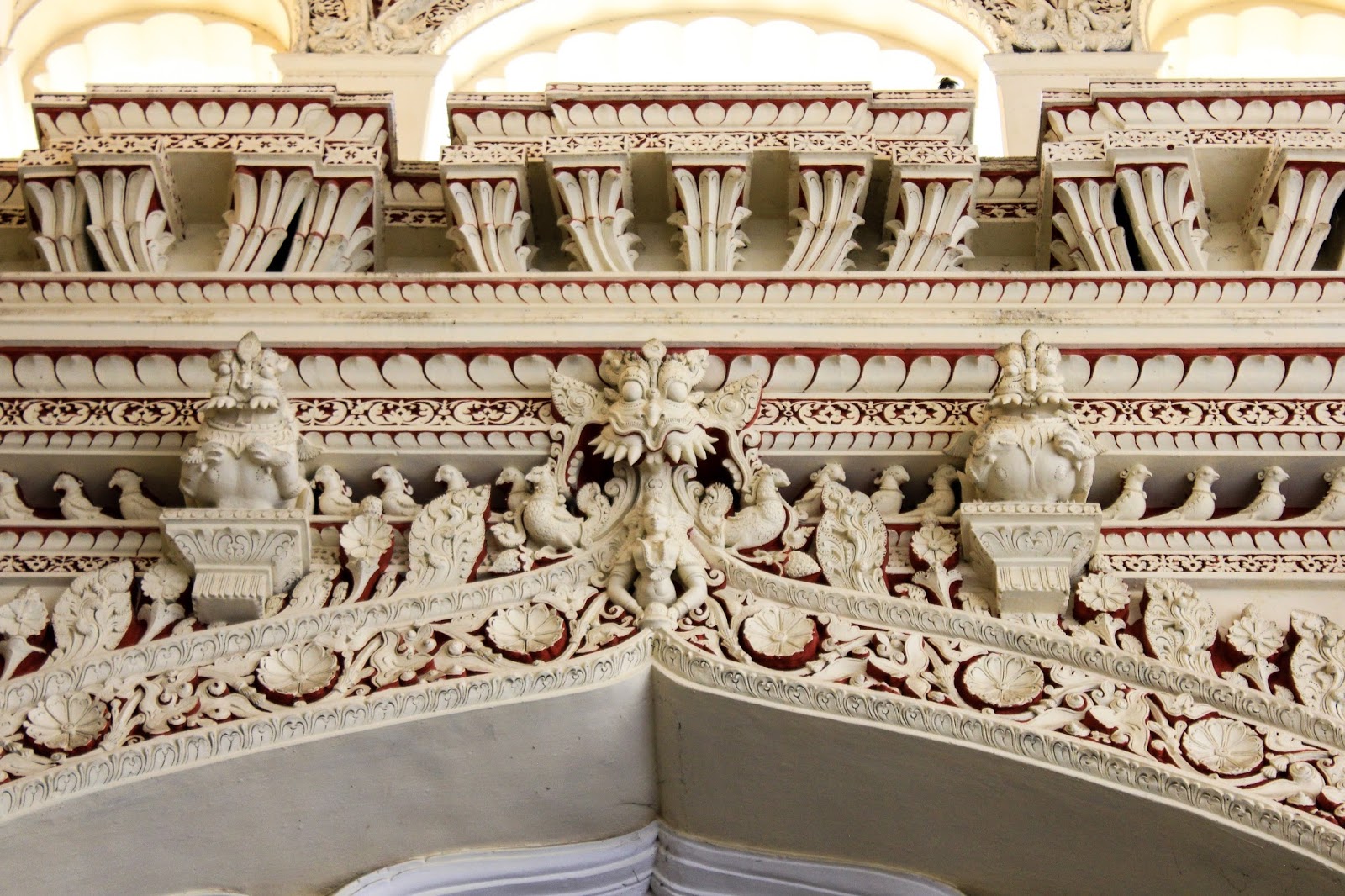
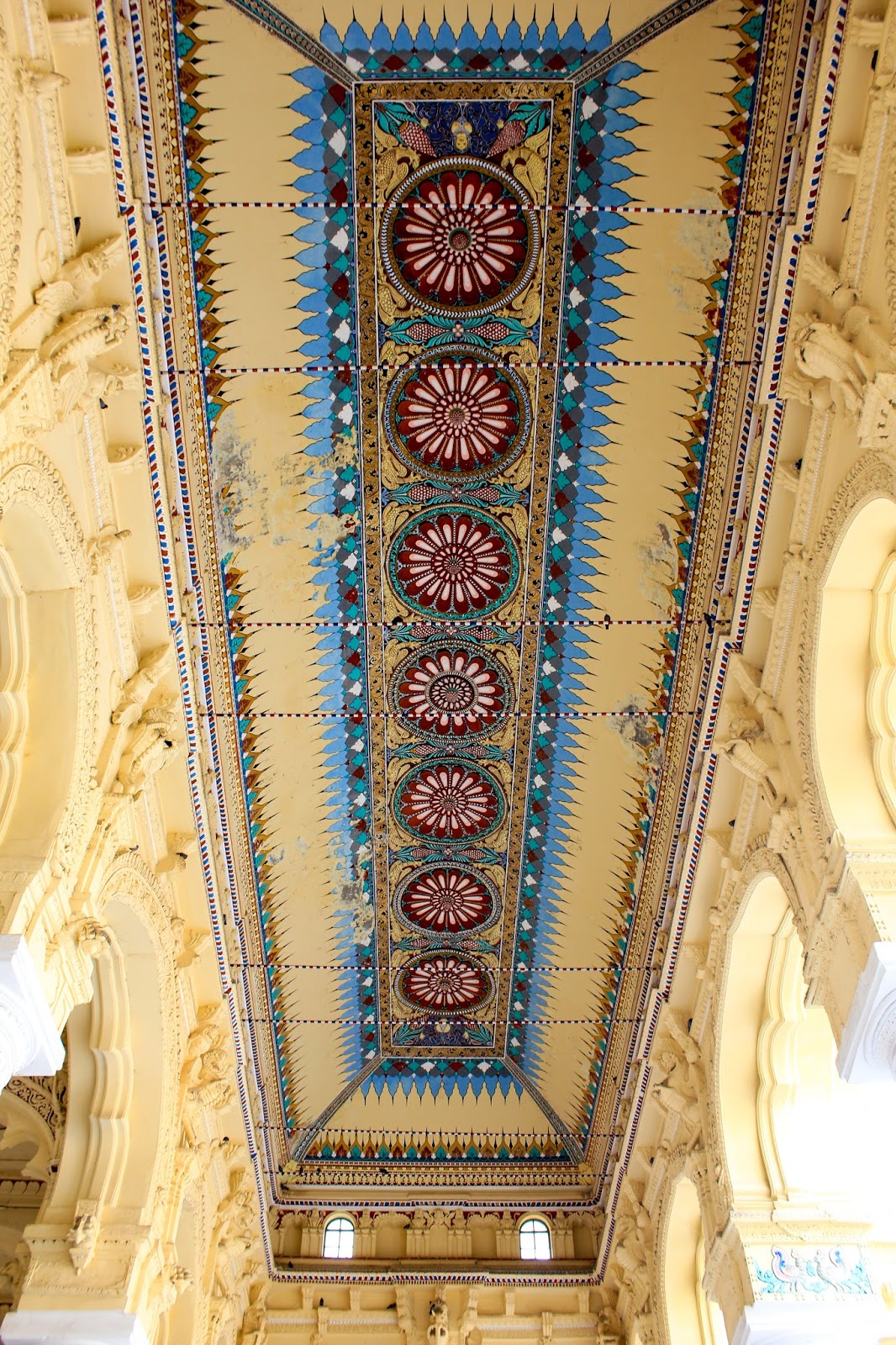
The next destination was the Thirumalai Nayakkar Mahal, and to call it a ruin is a deep understatement. Though only a quarter of the palace remains, you can admire the board white and golden columns, a reminiscent of the same white and golden colours of Manisha Koirala’s dress in the song Kannale Ennathu Kannai in the film Bombay.  The ornate cravings on the domes, and arches, and the painted ceilings add elegance to the simple structure.


The palace is a breather from all the congestion, noise and chaos omnipresent outside its walls.

On the way back from the temple, we paid a quick visit to St. Mary’s Cathedral, which drew our attention many times that day while crossing the signal. Unfortunately it was closed in preparation for next day Easter celebrations. But here are a few snaps I clicked from the outside!


Less than twelve hours in Madurai, and an essay on it isn’t justifiable, but I loved what I saw of the city. Most religious towns are littered with devotional songs playing out in speakers and sell only items for religious use, but in Madurai  you never do get a feeling you are visiting a temple town. Evening bazaars go on, selling everything from socks, to clothes to plastic buckets. Juice shops selling the Madurai famous Jigarthanda drink, old women selling jasmine flowers on the roadside, and you can find other electronic, furniture, antique stores that so rarely inhabit the premises of the temple surroundings. It is then not a temple town, but a town with a temple in it.

Friday, 5 May 2017

'Drinking Solo'....Let's Eat 3

Every episode of 'Drinking Solo' opens with Jin Jung Suk drinking alone, feasting on a variety of mouth watering food (as the camera so carefully zooms in and shows us.) In the background his voice explains the reasons and the rules he has set for himself for drinking solo every evening, (which we later learn is a result of betrayal from his seniors and annoyance of sucking up to them.) This sets whole theme of the drama; focusing on the act of drinking alone at the end of the day, reasons varying from a tiring yet satisfactory day to a broken heart.

As a college student, studying away from home, I would advise you not to watch this drama for the sole purpose of the unattainable desire it creates in you to eat all the food they showcase. I must have consumed a number of boxes of cup noodles the week I watched this show, just because that is the closest I can get to Korean food. 


Set in the background of an institution that tutors and prepares students for the civil service examinations, we get two distinct groups of characters - the teachers and the students, and most of the first half is spent in establishing their characters, their growing relationship with one another, and the love triangle(s) that ensue. It is only towards the end of the season is when the pace picks up, conflicts are arised and sorted out.

This isn't to say that the show doesn't have its moments. As most tvN dramas, they are heart warming, relatable, and most importantly, make us care for the characters. One instance would be when instead of Jung Suk and his conspicuous display of a food opening the episode, we have Hana slurping long strings of ramen with kimchi, and a can of beer. Instead of classical music, Urban Zapaka's 'I don't love you anymore' plays in the background, resonating with the heartbreak she experienced that day.
Another wonderful scene was when Hwang Jin Yi's boyfriend breaks up with her over a text after ignoring her calls for the entire day. As anger and a sense of shame falls over her, she gulps down a shot of soju and cries. At the same time, Min Jin Woong is sitting in his apartment after performing his mother's funeral rites, and along with him is Kim Won Hae. One desperately misses his mother, and the other refuses to go back home to his nagging in laws. In other scenes you would see they quarrelling and arguing, but here they sit in the messy, dim lighted apartment and quietly share a beer. Such small moments of melancholy hits us harder, as they are few in between all the fun and laughter.


My favourite character of all was Kim Dong Young, who was excellent as the cheapskate student. As a person who was out of all the love triangles stories, he was aware of everything the viewers were aware of, and not the characters themselves. So it felt like he was one of us, watching the drama unfold in front of his eyes.

Drinking Solo has its heart in the right place, and even it isn't for the plot line, you can watch it for the lovable characters, the food, the relatable student life situations or that satisfactory click of opening a can of beer that plays out throughout the show!

Sunday, 23 April 2017

A trilogy of a sort...

I spent my weekend binge watching three of Asghar Farhadi's movies - A Separation, About Elly and The Past. 
All three are beautifully directed suspense dramas, that revolve around a certain change or incident in the family, and the domino effect that falls upon the family and friends.
In both About Elly and The Past, the character that is the eye of the storm, is physically absent, but their presence is felt through repeated conversations involving them, and what they did,what they felt. 

What I loved most (in all three movies) was how the truth unfolds through conversations, arguments, confrontations, between family members, friends, colleagues, revealing the little grey area between the black and white of right, and wrong, or true and false.
All movies are devoid of any background score, and relies entirely on the weather, the cries of children, the cluttering of crockery; creating a sense of being with the characters, and not letting the viewers decide what they should feel.

I am not going reveal more, but if you love a slice of life dramas, Farhadi's movies are a must watch.

Tuesday, 18 April 2017

Bullet Point review: Lucky Romance


  •  It's the perfect length. Not too long, not too short. It doesn't keep you wanting more, but you are still satisfied with what you saw.
  • The initial tone of the story is pretty serious for a romantic comedy, but it throws light into Shim Bo Nui's fetish with superstitions, and Je Soo Ho's troubled relationship with his parents. This helps cut out the two distinct characters, who are completely opposite to each other in both their backgrounds, beliefs and nature, and with this out of the way, the story then focuses on the lighter things.
  • The transition of both the lead characters is shown excellently, with each one bringing out their flaws in subtle ways, helping them come to face with it.
  • One major aspect I loved about this show was how Soo Ho steps back and gives Bo Nui's time to think, when she isn't ready to be in a relationship. He never demands anything from her, yet reassures her that he will always be waiting, and she can take how much ever time she wants.
    How many times have I seen this respect for a girl's decisions in a drama, uh?
  • The romance is extremely cute, funny and cringe-y.
  • Ryu Jun Yeol gets the girl in this one. YES.
  • Everyone knows everyone in this drama-verse, so let's turn a blind eye to it.
  • You don't miss anything, if you don't watch it, but you don't lose anything if you watch it.

Sunday, 16 April 2017

Puthandu Vazthukal!

Wishing everyone, a Happy Tamil New Year! Here's another chance, to set another list of resolutions, and struggle to stick by them.

I was busy travelling this holiday, exploring the nooks and corner of a temple town.
Here's a clue,


Any guesses, to where?

Thursday, 30 March 2017

Moon Lovers : Scarlet Heart Ryeo - A gripping first half, but falters later on.

My main problem with the show was this - Why exactly is Hae Soo/Go Ha Jin, travelling back in time?
We understand from the first scene that she is in huge debt, and at a shock after being cheated by her boyfriend and her best friend. So, a travel to the past, is a nice way of saying, here, I am going to dump you in an era, where brothers kill each other for the throne, but hey, at least you are debt free!

It works to an extent. Within an episode, Hae Jin (a.k.a Hae Soo in Goryeo) gets used to the huge gap in technological advancements, language, importance of family statues etc etc. And for some part it doesn't matter. The show progresses tightly, showing us the blooming romance between Wang Wook and Hae Soo, and parallely the tragic story of Wang So, the abandoned prince. But it goes downhill once Wang Wook turns his back on Hae Soo, and then we are getting the half hearted turns of the brothers to ascend the throne. Everything and anything that happens is pinned on the heroine, and she suffers the consequences. Honestly, it stops surprising you after some time.

The second half loses the consistency of the former half. Characters become mere sketches, to fulfil a stereotype in the story. Wang Wook changes into a stoic man, whose only aim becomes acquiring the throne, Yeon Hwa oscillates between wanting to marry So, make her brother the king, or make herself become the queen. (It gives a headache at times.) Wang Yo becomes the guilt ridden (cues towards Macbeth) king and remove or keep Prince Eun, and Wo Hee, it doesn't matter for the story.

Instead,I would have loved to see more of Wang So's past, to why he became so brutal, to why his own mother resents him so much, and his relationship with his other two brothers going beyond their goals of becoming kings.

The problem also was that I kept expecting some tie between the past and the present to show up, as an evidence to why Hae Soo is actually here to change the past. But we are never shown that. If we had seen Wang So as a bloody tyrant, it would have been exciting to watch Hae Soo, try change and events in the past, to prevent him from becoming a king, or a tyrant.

I also never bought Wang So's and Hae Soo's love story, as I did with Wang Wook. The confused feelings of hatred, fear and love between them, was never sorted out, but rather just shown and then solved by a mere hug, or few gentle words, till the next problem popped up.

All this doesn't hinder the fact that the drama was beautifully shot. The locations, the costumes, everything was gorgeous. And as this is my first historical drama, it was a breath of fresh air - away from the towering glasses in Seoul to the calm, large courtyards of palaces.